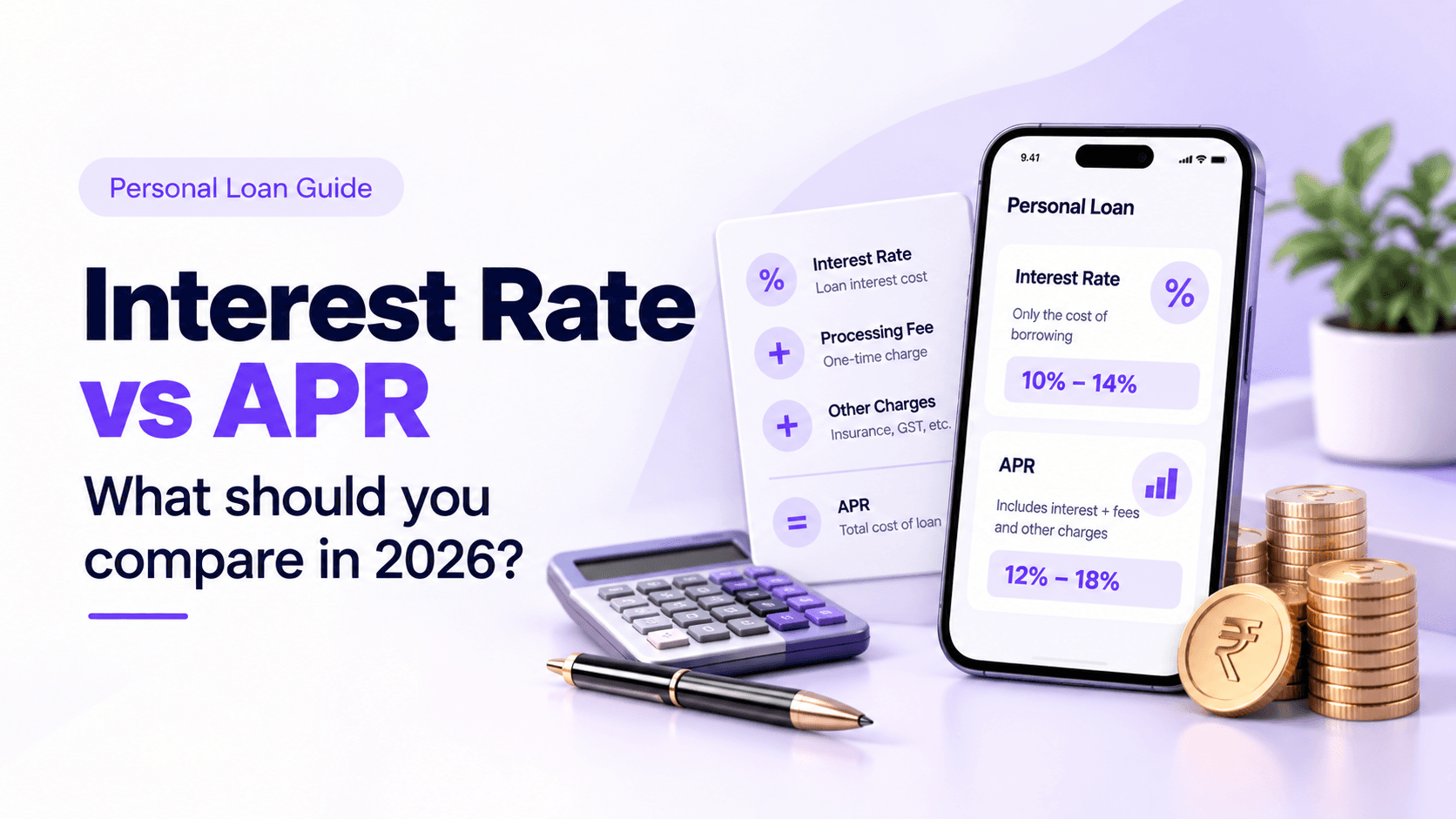
Interest Rate vs APR on a Personal Loan: What Should You Compare in 2026?
When you compare personal loans, the first number you usually notice is the interest rate: 10.5%, 11.99%, 13%, and so on.
But the interest rate is not always the complete picture of what a loan costs.
A loan can have a competitive headline rate and still cost more once processing fees and other applicable charges are included. That is why borrowers should look beyond the headline percentage and read the Annual Percentage Rate (APR) and the Key Fact Statement (KFS) before accepting an offer.
Interest Rate vs APR: The Simple Difference
Think of it this way:
| Interest Rate | APR | |
|---|---|---|
| What it tells you | The rate used to calculate interest on the loan | A broader annualised measure of the cost of credit |
| Includes loan interest? | Yes | Yes |
| Reflects applicable upfront credit costs? | Not by itself | Designed to reflect the applicable overall cost under the relevant rules |
| Best use | Understanding the interest component | Comparing the overall cost of credit |
The exact components included in APR depend on the applicable regulatory framework and loan product. RBI rules require relevant lenders to disclose APR in the Key Fact Statement for covered loans.
Why a 10.5% Loan Can Still Cost More
Imagine you are comparing two offers for a ₹2 lakh personal loan.
Offer A
- Interest rate: 10.5% p.a.
- Processing fee: ₹5,000
- Other applicable charges: ₹1,000
Offer B
- Interest rate: 11.25% p.a.
- Processing fee: ₹1,500
- Other applicable charges: ₹500
Looking only at the interest rate, Offer A appears cheaper.
But the difference in fees changes the calculation.
That does not automatically make Offer B cheaper or Offer A more expensive. The correct comparison depends on the loan amount, tenure, repayment schedule, applicable charges and APR shown in the lender's documentation.
The lesson is simple: don't compare two personal loans using the interest rate alone.
What Is a Key Fact Statement?
The Key Fact Statement (KFS) is designed to give borrowers important loan information in a standardised, easier-to-understand format.
RBI's framework requires covered regulated entities to provide borrowers with key information about the loan, including its all-in cost. APR is disclosed in the KFS for applicable loans.
Before accepting a digital or retail loan, look for:
- Loan amount
- Tenure
- Interest rate and whether it is fixed or floating
- APR, where applicable
- EMI or repayment schedule
- Processing fees and other applicable charges
- Prepayment or foreclosure terms
- Penal charges, where applicable
- Other important conditions
Don't treat the KFS as paperwork to skip. It is one of the most useful documents for comparing loan offers.
A Worked Example
Suppose you borrow ₹3 lakh for 24 months.
Lender A advertises 10.5% p.a.
Lender B advertises 11.25% p.a.
At first glance, Lender A looks cheaper.
But now imagine Lender A has a substantially higher processing fee while Lender B has a lower fee.
Your comparison should include:
1. Total interest
How much interest will you pay over the full tenure?
2. Upfront fees
How much is deducted or charged when the loan is processed?
3. Other applicable charges
Check documentation, verification, insurance or other charges that actually apply to the particular offer.
4. Prepayment terms
If you expect to repay early, understand the applicable prepayment or foreclosure conditions.
5. APR
Use the disclosed APR as an additional comparison point for the overall cost of credit.
Don't Make the EMI Your Only Comparison
A ₹7,000 EMI can look better than a ₹8,000 EMI.
But the lower EMI may simply come from a longer tenure.
For example, a longer loan tenure can reduce the monthly payment while increasing the total interest paid over the life of the loan.
So compare at least these three numbers:
Monthly EMI + Total Interest + Total Applicable Charges
Then look at the APR and KFS to understand the broader cost structure.
Fixed Rate vs Floating Rate
The type of interest rate matters too.
With a fixed-rate loan, the interest rate generally remains fixed according to the loan agreement.
With a floating-rate loan, the rate can change when the relevant benchmark or lending rate changes, subject to the loan terms.
For floating-rate personal loans covered by RBI's rules, borrowers should also pay attention to how a rate reset could affect the EMI or remaining tenure.
This is another reason to read the KFS and loan agreement instead of relying only on the number shown in an advertisement.
A 5-Minute Loan Comparison Checklist
Before accepting a personal loan, ask:
- What is the actual interest rate?
- Is it fixed or floating?
- What APR is disclosed in the KFS?
- What is the processing fee?
- Are there any other applicable charges?
- What will I repay in total?
- What is the exact tenure?
- What happens if I prepay or foreclose?
- What are the consequences of a missed EMI?
- Who is the actual regulated lender?
If you cannot answer these questions from the loan documents, don't rely only on the advertisement.
Should You Always Pick the Loan With the Lowest APR?
Not necessarily.
APR is an important comparison measure, but your decision should also consider the loan amount, tenure, repayment flexibility, rate type, prepayment terms and whether the product actually fits your financial needs.
For example, two offers may have similar APRs but different repayment structures.
The goal is not simply to find the smallest percentage on the screen. The goal is to understand what you will actually owe, when you will owe it, and under what conditions.
Use a Calculator Before You Borrow
Once you have the actual loan terms, calculate the EMI and total interest instead of relying on an advertised monthly number.
You can use the Make Loan Eazy EMI & Prepayment Calculator to model different loan amounts and tenures before making a decision.
A small change in tenure can make a meaningful difference to total interest, so running two or three scenarios can be useful.
Frequently Asked Questions
Is APR the same as the interest rate?
No. The interest rate describes the rate used to calculate interest, while APR is a broader annualised measure of the cost of credit under the applicable framework.
Why is my APR higher than my interest rate?
Applicable fees and other credit costs can make the overall annualised cost higher than the headline interest rate.
Where can I find the APR?
For loans where APR disclosure is applicable, check the Key Fact Statement (KFS) and loan agreement provided by the lender.
Should I compare personal loans only by APR?
No. Also compare the loan amount, tenure, EMI, total interest, applicable fees, rate type and prepayment conditions.
Is a lower EMI always better?
No. A lower EMI can result from a longer tenure, which may increase the total interest you pay.
Bottom Line
When comparing personal loans in 2026, don't stop at the headline interest rate.
Check the APR, KFS, total interest, applicable fees, tenure and repayment conditions together.
A loan that looks cheaper in an advertisement may not have the lowest overall cost once all applicable terms are considered.
Disclaimer: This article is for general educational information and is not financial advice. Loan rates, fees, eligibility, APR and other terms vary by lender, borrower profile, loan amount and tenure. Always read the lender's Key Fact Statement, loan agreement and schedule of charges before accepting a loan.