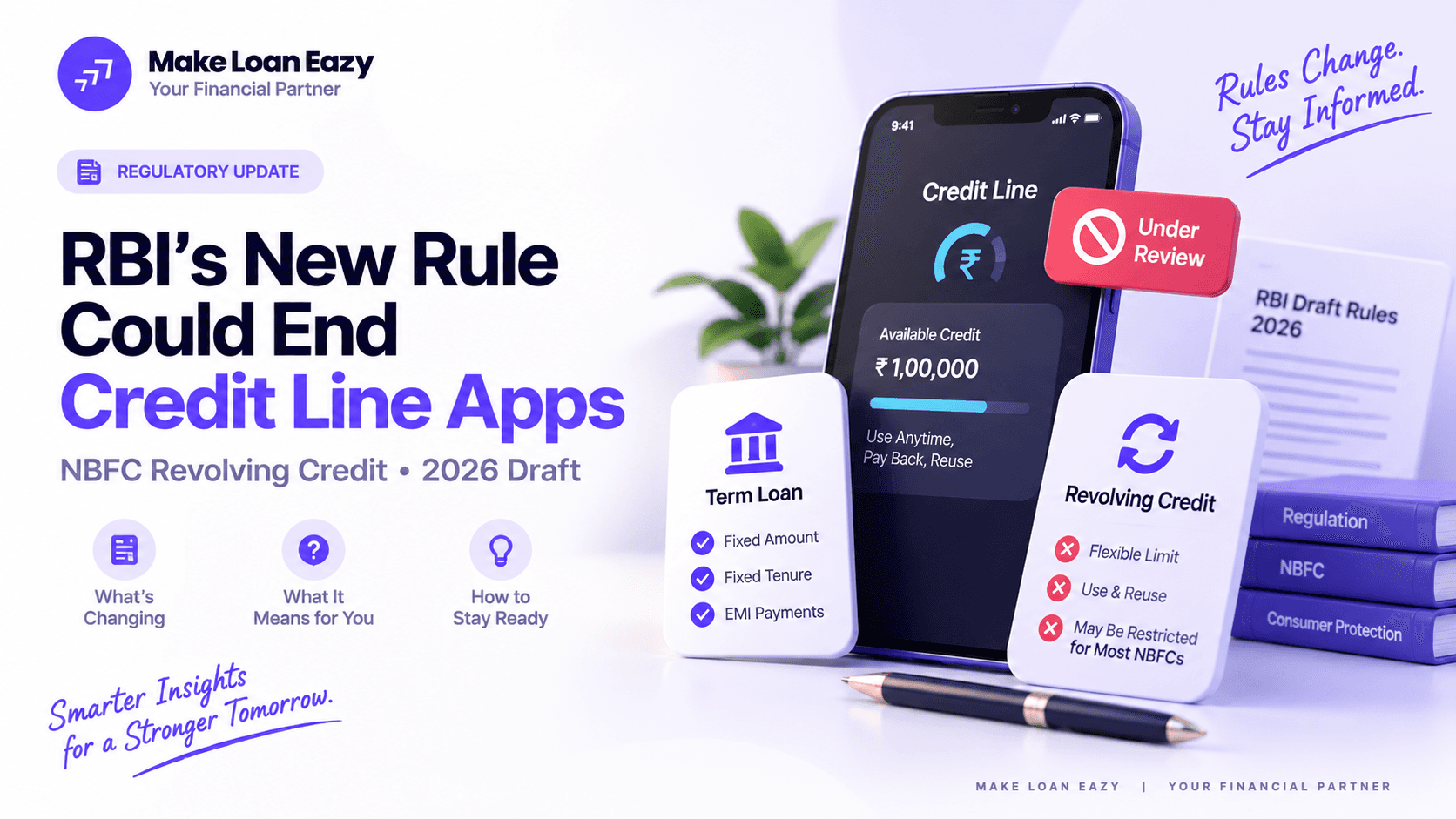
If you use a credit-line app that lets you draw, repay and draw again from the same limit, you may have seen headlines about the RBI's 2026 proposal. The important distinction is that the August proposal is a draft, not a final new rule. On 7 October 2026, RBI Governor Sanjay Malhotra described it as a clarification of existing restrictions rather than a new rule, and said the regulator was still considering feedback before issuing final directions. Read the RBI's original draft notice and the Governor's reported clarification.
What RBI Proposed on 6 August 2026
The RBI released the draft Reserve Bank of India (Non-Banking Financial Companies – Credit Facilities) Amendment Directions, 2026 on 6 August 2026 and invited comments until 28 August 2026. The proposed paragraph 108A would require covered NBFCs to offer credit products in the nature of term loans rather than revolving credit. The draft's exception is for an NBFC authorised by RBI to issue credit cards.
The draft is still not the same as a final direction. The RBI's public consultation page records the proposal as closed after the 28 August comment deadline. In his 7 October post-policy press conference, the Governor said the proposal was intended to clarify restrictions that the RBI considered already applicable, acknowledged that the regulator had received substantial feedback, and said the final directions would be issued after the feedback was examined. As of 15 November 2026, do not treat the draft wording as a newly commenced final rule.
What the Governor Clarified in October
The Governor's clarification changes how borrowers should read the headlines. He said the proposal was not a new rule or law, explaining that NBFCs had previously been warned about offering revolving credit in this manner. He also said the RBI was reviewing industry feedback, including requests for clarity on the definition and treatment of particular products. The final wording and treatment of existing facilities therefore remain important open questions.
The draft would add explicit definitions to the NBFC Credit Facilities Directions. Understanding the difference still helps borrowers identify how their facility is structured, but the draft should not be described as a final ban already in force.
| Term Loan | Revolving Credit | |
|---|---|---|
| How it's disbursed | A fixed, sanctioned amount, given in one go or in instalments | A limit you can draw from repeatedly |
| What happens when you repay | The loan is closed — done | Your available limit is restored, and you can borrow again |
| Repayment structure | A predetermined EMI schedule | Flexible — pay minimum or more, reuse what you repay |
| Common examples | A personal loan, a car loan, an education loan | A "credit line" app, an overdraft facility, a flexi loan, some pay-later products |
Under the draft, once you repay a term loan, that sanctioned limit cannot be restored or reused — you'd need a fresh loan for further borrowing. Revolving credit is exactly the opposite: draw, repay, and draw again from the same approved limit, often with no fixed end date.
What Kind of Products Does This Actually Affect?
If the amendments are notified as drafted, several common lending products offered by NBFCs would need to be restructured or discontinued:
- "Credit line" apps that let you draw funds on demand up to a pre-approved limit, common in the retail fintech space.
- Flexi loans, where you're sanctioned a limit and can withdraw and repay in parts over time.
- Overdraft-style facilities, similar to a bank overdraft but offered by an NBFC.
- Digital "pay later" products built on an NBFC partnership rather than a bank-issued credit card.
This does not affect a standard personal loan, car loan, or any product where you receive a fixed amount and repay it on a set schedule — those already fit the term loan definition and aren't touched by this change.
Why the RBI Is Doing This
The RBI's stated concerns include the risks of repeated borrowing without a clear repayment path, loan evergreening and liquidity vulnerabilities at lenders. The Governor's October clarification also stressed that the RBI was weighing systemic-risk concerns against the need for legitimate funding options. Because the proposal remains under consideration, avoid treating every credit line, overdraft or pay-later product as automatically prohibited without checking the lender type, product structure and final directions.
What This Means If You Use One of These Products
If you currently use an NBFC-issued credit line, flexi loan, or overdraft-style facility, here's what to actually watch for:
- Check whether your credit facility is from an NBFC or a bank. This rule specifically targets NBFCs (other than authorised credit card issuers). A bank-issued credit card or overdraft isn't affected by this draft.
- Do not assume an immediate change today. The draft says it would take effect immediately upon final notification, but the Governor said feedback was still being examined. Ask your lender whether it has issued any formal communication about your particular facility.
- Expect possible product changes from your lender. Your NBFC may convert your existing facility into a series of term loans, ask you to close it out, or offer a replacement product that complies with the new structure.
- Don't assume your available "reusable" limit will behave the same way going forward. If your facility gets reclassified, a repaid amount may no longer automatically restore your available credit the way it used to.
- Reach out to your lender directly for clarity if you rely on a revolving facility for regular cash flow — early clarity on whether your specific facility can run to maturity or will need restructuring is worth getting in writing.
It's also worth being cautious about the app itself. If you're using a lending app you're not fully sure is properly backed by an RBI-regulated entity, our guide on how to check if a loan app is really RBI-registered walks through exactly how to verify this before you borrow — a genuinely useful check regardless of how this specific rule plays out.
The Industry Pushback
The NBFC sector's main representative body, the Finance Industry Development Council (FIDC), wrote to the RBI on 27 August 2026 — a day before the comment deadline — asking the regulator to soften the proposal. Their central ask: let a borrower who repays part of their principal early get that repayment headroom back, rather than losing it permanently, as long as appropriate guardrails prevent the facility from functioning as unchecked perpetual credit.
Whether the RBI accommodates this in the final directions remains to be seen. Until the final rules are notified, existing NBFC revolving credit products continue to operate as they currently do.
Why a Term Loan Might Actually Be the Better Choice Anyway
Even setting the regulatory change aside, a term loan has real advantages over revolving credit for most borrowers trying to manage their finances carefully:
- A fixed EMI is easier to budget around than an open-ended facility where the temptation to keep drawing can quietly build up debt.
- A defined end date gives you a clear finish line, rather than a facility that can, in principle, continue indefinitely.
- It's easier to track your Fixed Obligation to Income Ratio (FOIR) — how much of your income is already committed to debt — with a fixed EMI than with a revolving balance that changes month to month. Our guide on understanding FOIR explains why this matters for your own financial planning, regardless of what regulators require of lenders.
- Consistent term-loan repayment can build a stronger credit history, since a clear repayment pattern on a fixed-schedule loan is straightforward for the credit bureau to track and reflect in your CIBIL score.
If you're evaluating whether to move from a revolving credit line to a straightforward personal loan — whether by choice or because your existing facility is being restructured — it's worth comparing the real numbers. MLE's EMI & Prepayment Calculator can show you exactly what a fixed-tenure personal loan would cost against what you're currently paying, and our Personal Loan page has current rates and eligibility if you're ready to explore it.
Frequently Asked Questions
Does this rule affect my personal loan? No. A standard personal loan — a fixed amount disbursed once and repaid through a set EMI schedule — already fits the definition of a term loan. This draft only restricts revolving credit products.
Is this rule already in effect? The August 2026 text is a draft, not a final amendment shown as in force. The comment period closed on 28 August. On 7 October, the RBI Governor said the draft was a clarification of existing restrictions and that the RBI was still considering feedback before issuing final directions. Check the RBI's current notification list before acting on a headline.
What happens to my existing credit line if this rule is finalised? This isn't fully clear yet, since the draft doesn't specify how existing facilities should be treated. Your NBFC may restructure your facility into term loans, offer an alternative product, or ask you to close it — it's worth asking your lender directly for clarity on your specific account.
Does this apply to credit cards? The draft includes an exception for an NBFC authorised by the RBI to issue credit cards. Do not assume a lender qualifies simply because it markets, distributes or co-brands a bank-issued card.
Why is the RBI restricting revolving credit for NBFCs? The RBI has cited concerns about NBFCs extending large volumes of credit through perpetual, revolving facilities without a clear repayment schedule or robust assessment of a borrower's repayment capacity — a pattern that can mask underlying repayment stress rather than resolve it.
Does this apply to bank-issued overdrafts or credit lines? This specific draft targets NBFCs under the Credit Facilities Directions. Bank-issued products are governed separately and aren't the subject of this particular amendment.
Disclaimer: Loans and investments are subject to credit assessment and market conditions. Please read loan terms and scheme-related documents carefully before proceeding.